
How to Check Criminal History in Sabine Parish
No single Sabine Parish database contains every arrest, prosecution, sentence, and custody change. The best first stop depends on the question. The Sabine Parish Clerk of Court maintains the 11th Judicial District Court file. The Sabine Parish Sheriff’s Office holds its arrest and jail records. Louisiana State Police BCII compiles reported statewide criminal-history cycles, while Louisiana DPS&C reports current state imprisonment.
Gather a complete name, alternate spellings, approximate date of birth, arrest or filing year, and any case or booking number. Treat a same-name result as a lead until another identifier confirms it.
- Call the clerk at 318-256-6223 for a known parish prosecution or use the available clerk search channels.
- Search by party name or case number and narrow the result by filing year and case type.
- Ask the sheriff for an initial report or booking entry when the event began with a local arrest.
- Read charges, minutes, disposition, and sentence together rather than relying on the first docket line.
- Order a certified clerk copy or official BCII self-review when formal proof is needed.
The Many Courthouse Record Hub
The official Louisiana parish overview provides statewide context for the local offices.
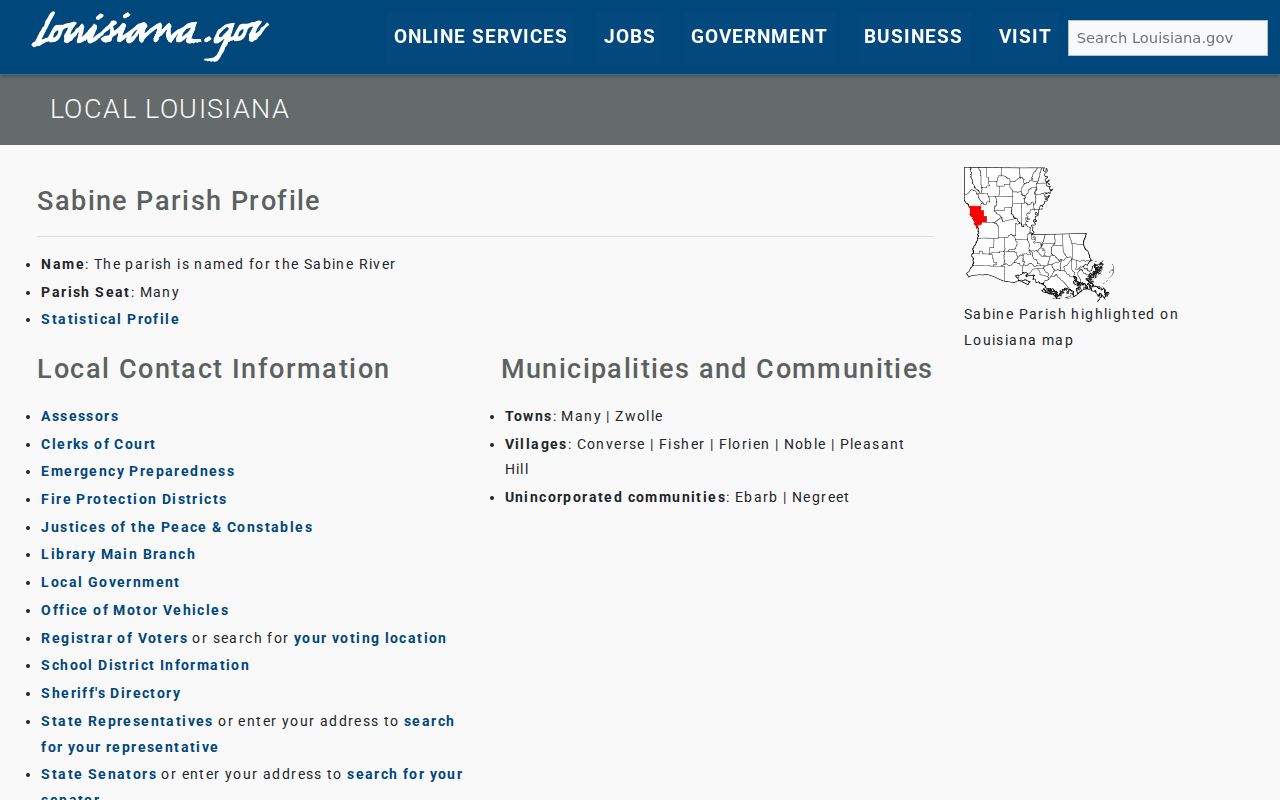
This official overview confirms the jurisdiction before a reader selects a record custodian.
The Sabine Parish Courthouse at 400 South Capitol Street, Many, LA 71449 is the central stop for parish criminal case records. The clerk keeps criminal, civil, probate, land, and marriage records and invites callers to confirm access before traveling. That matters across a parish covering roughly 1,115 square miles. The public calendar separates criminal jury weeks, arraignments, misdemeanor settings, and pretrial settings, but a calendar shows scheduling, not the outcome of a case.
Clerk of Court
11th Judicial District Court
400 South Capitol Street
Many, LA 71449
318-256-6223
Sheriff and Jail
Confirm the current counter address, extension, and hours through the official sheriff site before travel.
State Repository
Louisiana State Police BCII handles eligible official checks and personal Louisiana record review.
Official Louisiana Background Checks
The Louisiana State Police background-check page supplies current forms and instructions.
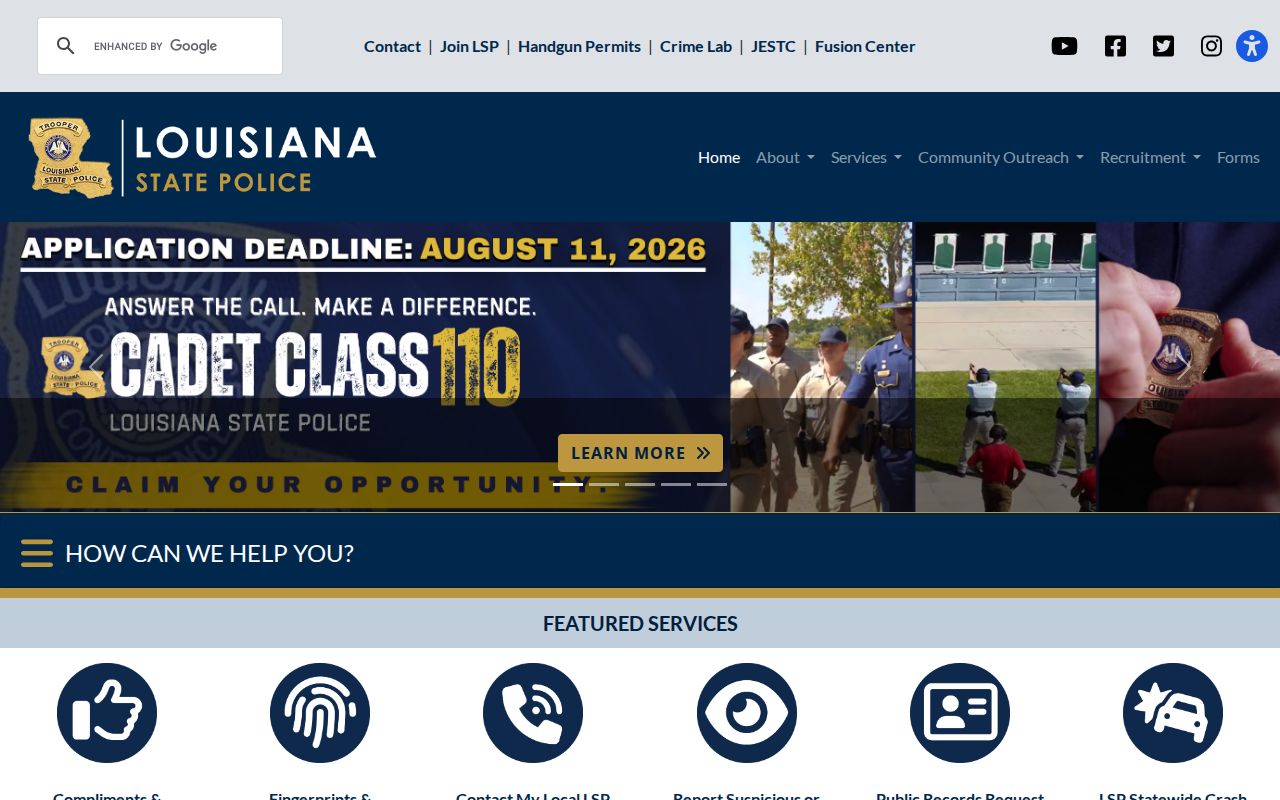
Its current instructions control whenever an older form or fee reference differs.
The Louisiana Department of Public Safety and Corrections, Office of State Police, Bureau of Criminal Identification and Information is the state repository. Louisiana does not provide a general anonymous pay-per-name conviction portal. Release depends on the requester and statutory purpose. A person seeking their own Louisiana record should follow the State Police background-check process, which may require the correct form and fingerprints.
State Police or BCII fingerprint cards and authorized LiveScan are the official state channels. Local fingerprint availability should be confirmed by telephone. Official fiscal materials commonly show $26 state processing, but the exact fee and form must be verified for the request purpose.
From Booking to Final Disposition
Sabine Parish records are created in sequence. An arresting agency writes the initial report and arrest paperwork. Detention staff create a separate booking record, photograph and fingerprint the person, list charges, inventory property, and record bond and custody status. Fingerprints and event data are routed to BCII. The district attorney decides whether and how to file charges, and the clerk opens the court case.
Record flow: Incident › Arrest › Booking › Prosecutor review › Court case › Disposition › State update
A booking proves custody, not guilt. The court file is the better source for the charge pursued and its outcome. A statewide history may need reconciliation with a certified clerk record if a disposition is delayed or missing.
Types of Criminal Records in Sabine Parish
Each record answers a different question and has a different custodian. Do not ask the sheriff for “all criminal history” when the goal is a final judgment.
- Arrest and booking records identify the agency, custody event, listed charge, bond, and release status.
- Criminal court files contain filed charges, motions, minutes, pleas, rulings, judgments, and sentences.
- Repository records aggregate reported Louisiana arrest and disposition cycles for eligible release or personal review.
- Warrant records begin with the issuing court and serving agency; public detail may be limited.
- Custody and supervision records separate parish jail status, state imprisonment, probation, and parole.
Requesting Sheriff Records Precisely
The sheriff does not publish a stand-alone records form, fee sheet, or dependable text-based request portal. Use the official sheriff site or Louisiana Sheriffs’ Association directory to confirm the current channel. Identify the record as an initial incident report, article 228 booking record, arrest entry, or releasable warrant information. Include the date range, location, arresting unit, report or booking number, preferred electronic format, and a cost ceiling.
| Request Field | Why It Helps | Required |
|---|---|---|
| Record type | Routes the request to the correct file | Yes |
| Incident or booking number | Provides the fastest unique match | If known |
| Date and location | Narrows manual searches | Yes if number unknown |
| Delivery and certification | Distinguishes review copies from official proof | Optional |
| Advance cost limit | Prompts an estimate before copying | Recommended |
The official Sabine Parish Sheriff website supplies current agency contact and service information.
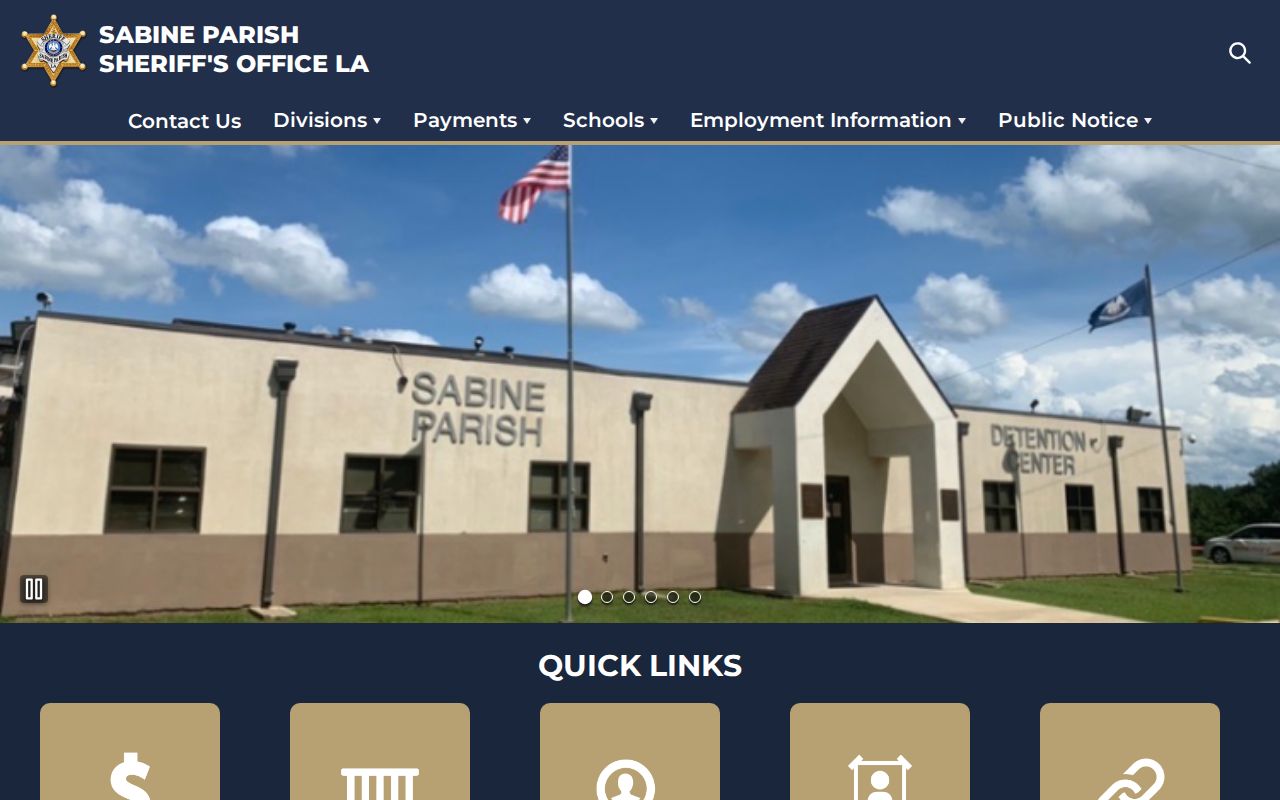
Checking the official page first prevents reliance on an old address or extension.
What a Sabine Parish Criminal Record Shows
A useful review separates identity data, alleged conduct, and the final court result. The same event can appear differently in a jail record, docket, and BCII history because each captures a different stage.
| Name & Identifiers | Name, aliases, birth data, and agency identifiers used to distinguish people. |
|---|---|
| Arrest / Booking Data | Arrest date, agency, booking number, charges, bond, and custody changes. |
| Charges & Statutes | Offense description, statutory citation, counts, and amendments. |
| Disposition | Dismissal, acquittal, plea, conviction, or another recorded resolution. |
| Sentence | Term, fine, credit, conditions, and court-ordered supervision. |
| Custody / Supervision | Jail release, state imprisonment, probation, or parole information where public. |
Jail, VINE, and State Custody
The Louisiana VINE service supplies the state custody-search and notification interface.

A VINE match should still be checked with the holding agency and court record.
For a recent local custody event, begin with the Sabine Parish Sheriff’s Office or its official mobile app. The app advertises detention-center information, inmate search, alerts, and contact functions, but availability can change and it is not a certified disposition source. Louisiana VINE helps locate people and provides custody notifications. Verify every match with the holding agency.
The DPS&C offender-information page explains the state locator route.
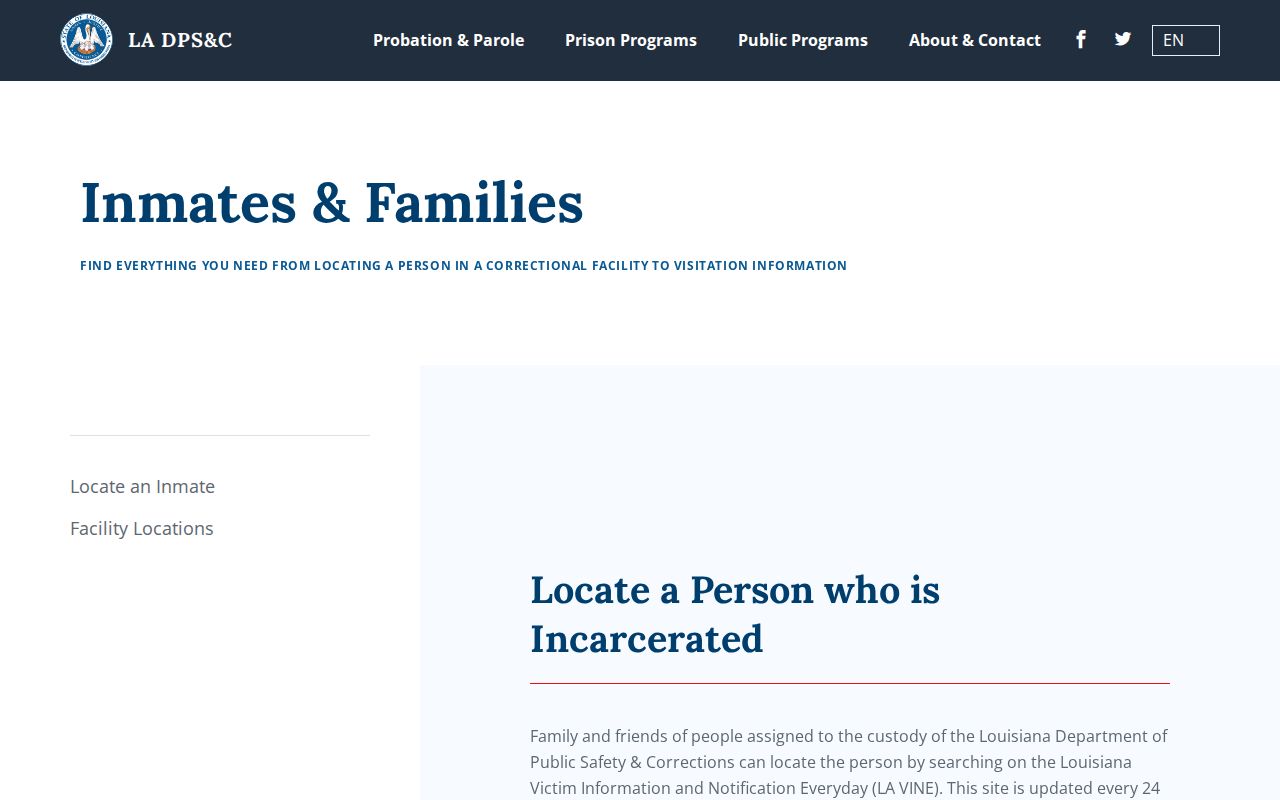
That distinction determines whether the sheriff or state corrections is the better source.
A person serving a Louisiana sentence may appear in the DPS&C Imprisoned Person Locator. State imprisonment is not the same as a parish jail booking. Court sentencing remains in the case file, and detailed supervision files are not a general public database.
Public Access Laws for Sabine Parish Criminal Records
The official text of R.S. 44:3 shows the line between public initial records and protected investigative work.
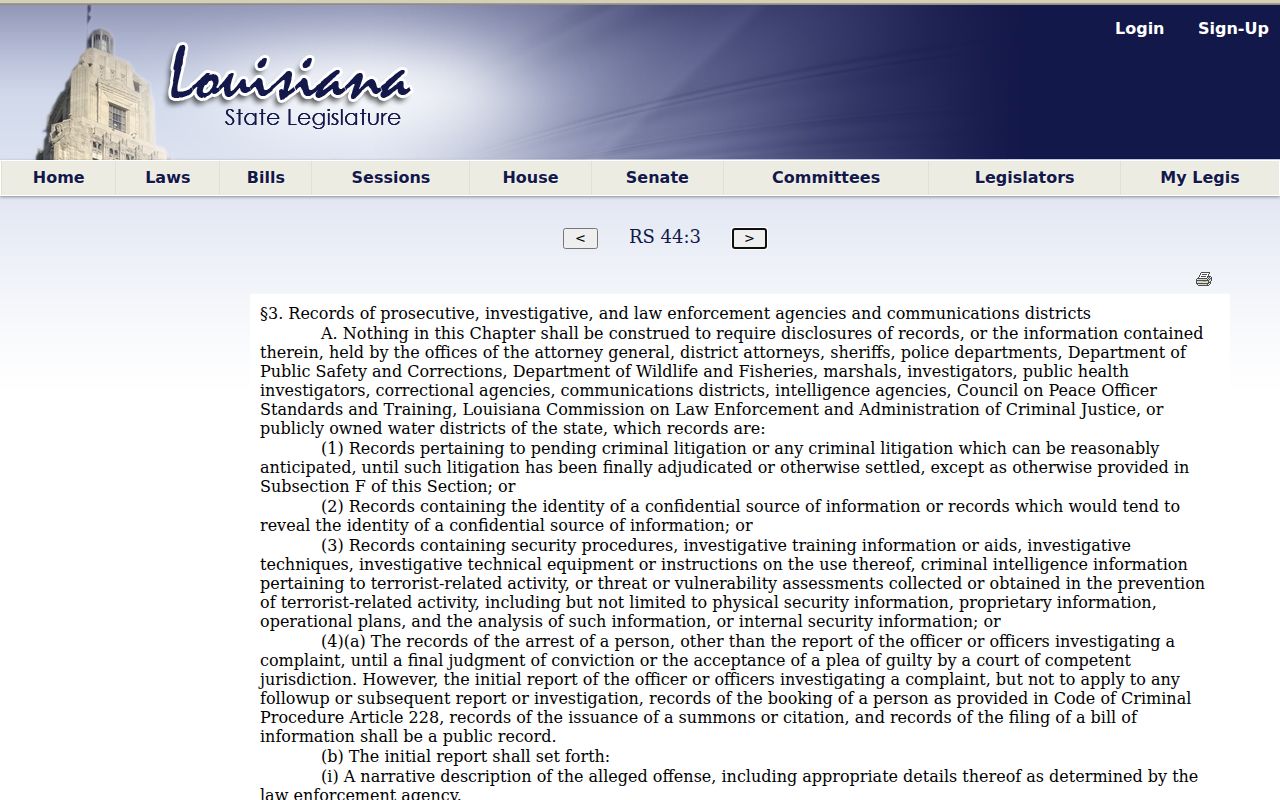
The statute supports a narrow request for the public portion rather than the whole investigative file.
Louisiana Public Records Law sets the broad framework, while specific laws control investigative, booking, repository, court-minute, juvenile, and expunged information. Public access does not make every page of an investigative file open.
Key Statutes:
La. R.S. 44:1 defines public records and the custodian framework.
La. R.S. 44:3 protects much pending investigative material but keeps specified initial, booking, citation, and charging records public.
La. R.S. 13:5992 requires electronic public access to district criminal minutes or summaries for cases filed from January 1, 2020.
La. R.S. 15:579 limits repository and juvenile dissemination.
C.Cr.P. art. 973 makes an expunged record confidential while preserving limited official access.
Clerk Indices and Statewide Minutes
The Sabine Parish Clerk website supplies official local office and index information.
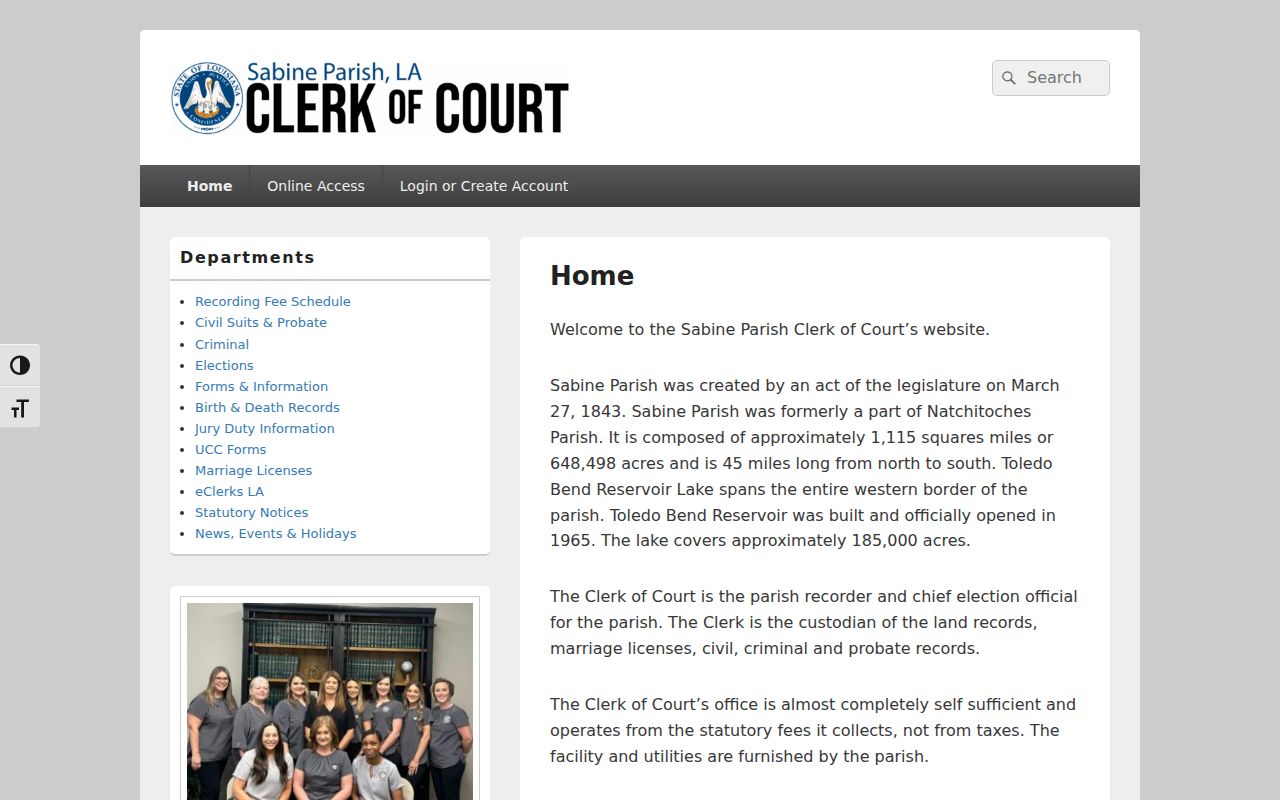
The clerk remains the contact for certified documents and questions about coverage.
The Sabine Parish Clerk advertises subscription access to online indices and asks users to call for added information, so criminal coverage and fees should be confirmed before subscribing. The Louisiana Clerks’ Remote Access Authority portal, also called eClerks LA, provides statewide clerk access. Under the post-2020 minute law, district clerks transmit public criminal minute entries or summaries for cases filed on or after January 1, 2020.
The LCRAA statewide portal displays the remote clerk-access entry point.
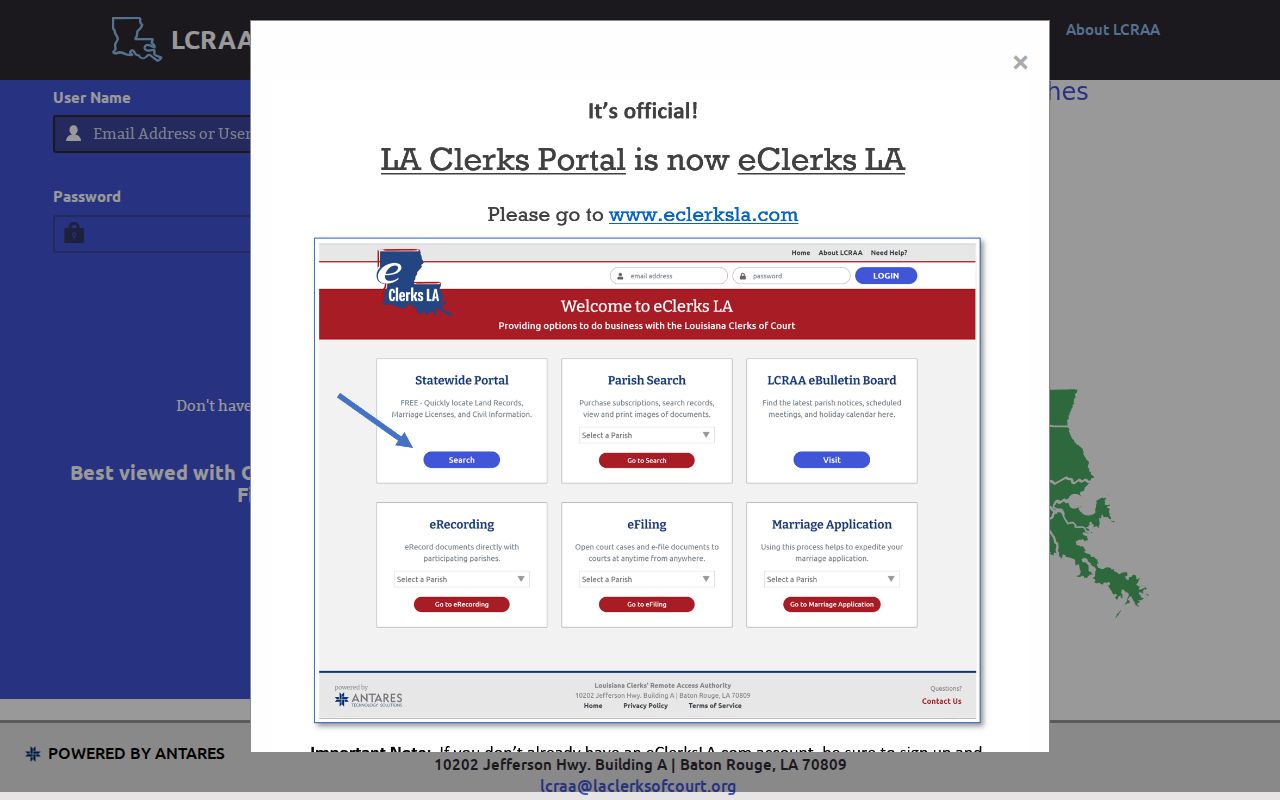
The portal view shows where remote access begins, not whether every older Sabine document is online.
An online minute may show that a hearing, plea, ruling, or sentence occurred. It is not always the complete pleading or signed judgment. For older files, missing entries, or certification, call the clerk with the name, filing year, and case number if known.
Sealed, Expunged, and Restricted Records
Louisiana expungement under Code of Criminal Procedure articles 971 through 995 makes an eligible record confidential; it does not necessarily erase every file from every repository. Eligibility and waiting rules differ for misdemeanor and felony matters. The prescribed motion asks for the court, arresting agency, arrest date, docket number, charge, disposition, and statutory basis. Reconcile those details before filing.
Juvenile information, protected victim data, expunged matters, and exempt investigative material may not appear publicly. Some agencies retain limited statutory access. A missing result does not prove an event never occurred. People reviewing their own history should compare the disposition with BCII and ask the reporting agency about a correction when records conflict.
Resolving a Sabine Parish Warrant
A warrant check starts with the issuing court or serving agency. Online silence is not confirmation that no warrant exists. A person addressing their own warrant should contact the clerk or sheriff through an official number, identify the court if known, and ask what appearance or bond instructions apply. Do not travel based only on an unverified match.
Service notes may remain restricted, while a court docket can show issuance, recall, or a later appearance. Read entries in date order to avoid treating an old warrant as current.
Criminal Records by City in Sabine Parish
Many, Zwolle, and Converse are the three largest incorporated places in the research profile. A municipal police report or mayor’s-court matter can begin locally, while a felony prosecution moves into the 11th Judicial District Court. City contacts add the first event or ordinance layer, but the parish clerk remains essential for district-court results.
Many Criminal History
Police contacts, local fine payment, sheriff custody, and parish court routes.
Zwolle Criminal History
Town and mayor’s-court contacts, plus district-court channels.
Converse Criminal History
Municipal routing and parish court, jail, and state records.
Costs and Copies
Sabine Parish sheriff copy fees and turnaround were not found in an official posted schedule. Ask for an estimate and request electronic inspection or delivery when available. The clerk is largely supported by statutory fees, but exact search, subscription, copy, and certification charges should be confirmed.
| Channel | Known Cost | Best Practice |
|---|---|---|
| Clerk case file | Confirm with clerk | State whether certification is needed |
| Sheriff record | No official local schedule found | Request estimate and set cost ceiling |
| BCII check | Commonly $26, verify purpose | Use the current official form |
| Online indices | Terms may apply | Confirm criminal scope before paying |
Probation and Parole Records
Adult probation and parole supervision in Louisiana is state-run through the DPS&C Division of Probation and Parole. The Sabine Parish court file shows that supervision was imposed as part of a sentence, including the term and conditions stated in the public judgment. Detailed supervision notes, risk assessments, home contacts, and internal case-management material are not a general public database. The Louisiana Committee on Parole within the Board of Pardons and Committee on Parole handles parole decisions, while DPS&C administers community supervision.
For a person reviewing their own case, first obtain the signed sentencing document and the latest court minute. Contact the appropriate state office for current supervision questions. Do not infer that supervision has ended merely because an old sentence date appears in a search result; later revocation, modification, discharge, or parole action may be recorded through another official channel.
Verify the Record at Its Source
Use the document closest to the fact. The sheriff is best for a local booking, the clerk for a filed charge and judgment, DPS&C for state custody, and BCII for an eligible statewide history. A name-only result can join different people, and an arrest without its disposition is incomplete. Keep the case number, request date, response, and certified documents together so later corrections can be traced.
When sources disagree, note which office created each record and the date it was last updated. Ask the clerk for the certified disposition, then provide that document to the agency or repository whose entry appears incomplete. A correction request should identify the arresting agency, arrest date, docket number, exact error, and supporting court order. Keep copies of correspondence and delivery confirmation. This record trail makes it easier to show that the problem concerns a missing or inaccurate update rather than a mistaken identity match.