
Criminal Cases in Sabine Parish Courts
The 11th Judicial District Court in Many hears Sabine Parish felony prosecutions and other district-court criminal matters. The Sabine Parish Clerk of Court is the custodian of bills of information or indictments, motions, minute entries, pleas, rulings, judgments, and sentencing entries. Call 318-256-6223 when a case cannot be resolved through remote access.
Mayor’s courts may handle municipal-ordinance matters, and their local record is not a substitute for a district prosecution. The Many payment link is a fine-payment channel, not a full criminal docket search. Identify the court shown on a citation before choosing a custodian. A sheriff booking entry belongs to the custody record and does not itself establish that the district attorney filed a court case.
Post-2020 Criminal Minutes Online
Louisiana’s Clerks’ Remote Access Authority portal, eClerks LA, is the statewide court access channel. Louisiana R.S. 13:5992 requires district clerks to transmit public criminal minute entries or summaries for cases filed on or after January 1, 2020. The Sabine Parish Clerk separately advertises subscription indices, but users should call to confirm criminal coverage, account terms, and fees.
A minute entry is a compact record of what happened in court, such as an arraignment, motion hearing, plea, ruling, trial setting, or sentencing. It may not include the full pleading or signed judgment. The local clerk is the correct source for certification, missing entries, older files, or a document needed to understand a short minute notation.
The official R.S. 13:5992 text establishes the post-2020 criminal-minute access rule.
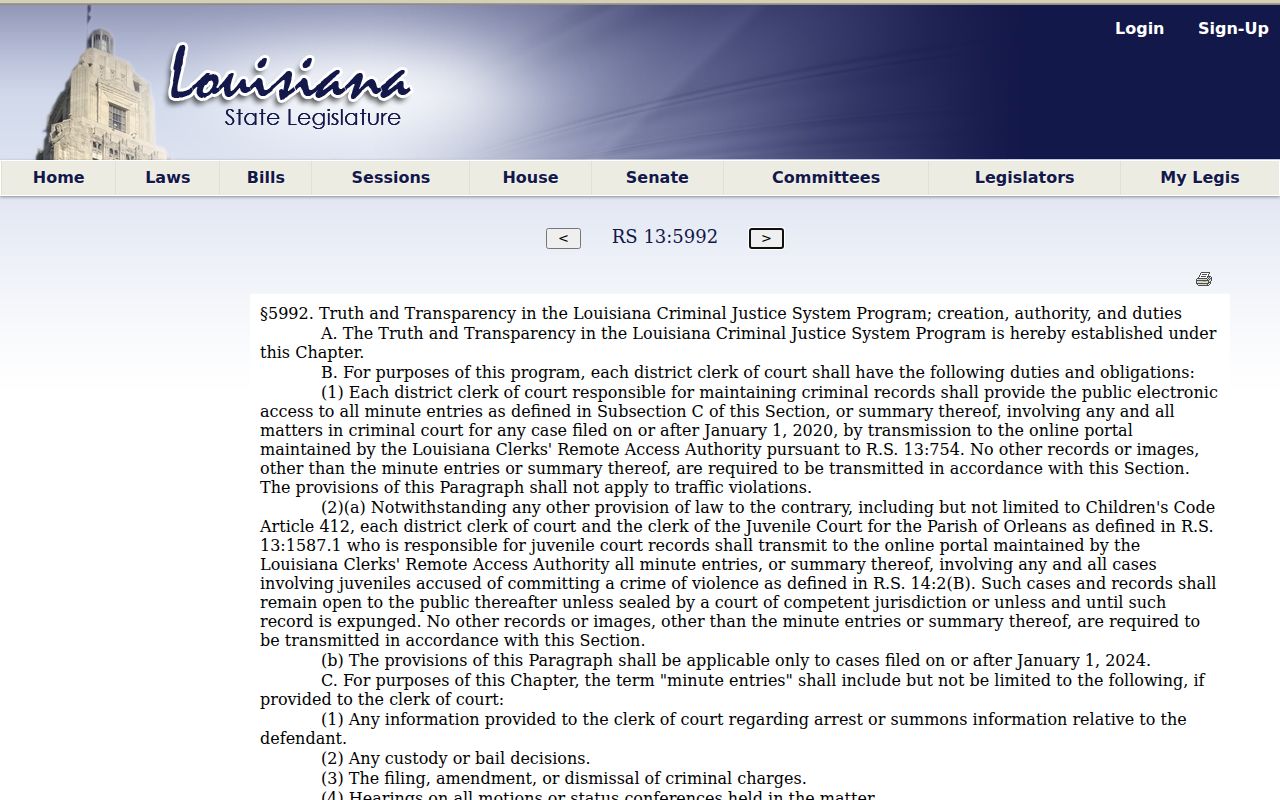
The statute explains why recent minutes may be remote while the clerk still holds the underlying pleading.
How to Search Sabine Parish Case Records
Start with the most specific identifier available. A docket number is stronger than a name, and a filing year helps separate people with similar names. Neither the research nor the public clerk material confirms every remote form field, so the table distinguishes practical search details from mandatory fields.
- Open eClerks LA or contact the Sabine Parish Clerk and select the criminal record channel available.
- Enter the docket number, or search the defendant’s full name with spelling variants.
- Narrow the match by filing year, court, case type, and birth information when the channel permits it.
- Open the minute or docket and read entries chronologically, noting amended charges and later rulings.
- Give the clerk the docket number and exact document title when ordering a copy or certification.
| Field Label | Type | Required | Notes |
|---|---|---|---|
| Last name | Text | For name search | Try former names and spelling variants |
| First name | Text | Practical | Add the full name when known |
| Docket number | Text | No | Best unique case identifier |
| Date of birth | Date | Not always exposed | Use only in an official channel that requests it |
| Case type / year | Select or text | No | Helps separate similar results |
Criminal Pleadings Changed in 2026
The Sabine Parish Clerk publishes criminal-pleading instructions tied to Act 352 and a January 1, 2026 electronic-submission change. This is chiefly a filing rule for practitioners, but it also helps a record reader understand why a recent pleading may enter the file electronically. It does not turn a filing channel into a public name-search portal.
When requesting a recent pleading, name the document precisely, such as the bill of information, motion, order, judgment, or sentencing minutes. Give the docket number and filing date if known. Asking for a defined document reduces confusion and avoids receiving only a calendar printout or a brief minute when the signed order is what proves the result.
The clerk’s criminal-pleading page documents the local electronic-submission instructions.
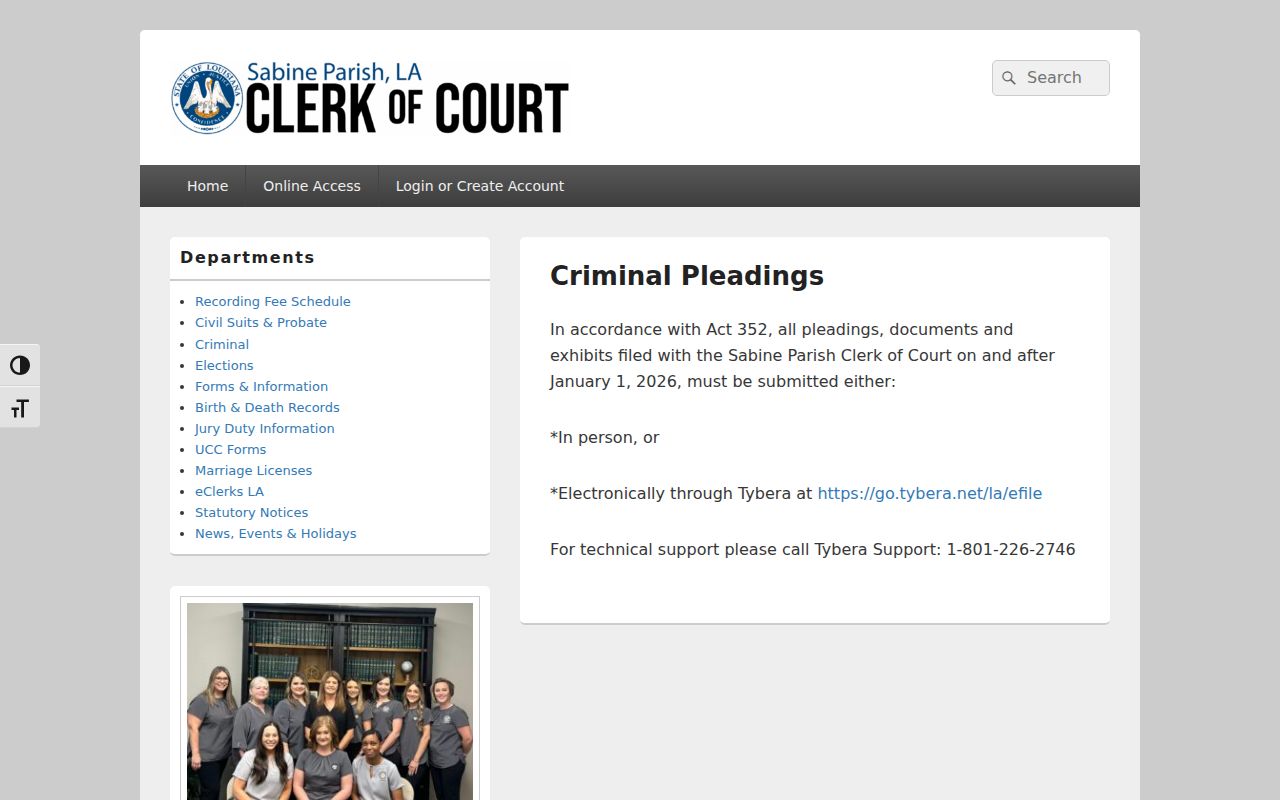
The change explains how recent filings enter the record, but it does not replace a public copy request.
What the Case File Shows
The court file records the prosecution rather than merely the arrest. Compare the charging document with later amendments and the disposition, because the booking charge may differ from the count ultimately pursued. Minutes provide the event sequence; signed judgments and sentencing entries provide stronger proof of the outcome.
| Case Number & Court | The docket identifier, division or court, filing year, and parties. |
|---|---|
| Charging Document | The bill of information or indictment listing filed counts and statutes. |
| Docket Entries | A chronological index of filings, appearances, motions, rulings, and settings. |
| Hearing Dates | Scheduled and completed appearances, which do not alone prove a disposition. |
| Disposition & Judgment | Dismissal, acquittal, plea, conviction, or other resolution and the signed ruling. |
| Sentence & Conditions | Custody term, fine, credit, conditions, and court-ordered supervision. |
Read Minutes in Date Order
A docket may preserve several charge descriptions as a case changes. Begin with the filed bill, then follow arraignment, motions, continuances, amendments, plea or trial entries, judgment, and sentence. A “set” or “continued” entry indicates scheduling, not guilt or dismissal. A later amended charge controls over an earlier description when the court record says it replaced the former count.
- Docket
- The chronological index of case events and filed documents.
- Minute entry
- A concise official account of what occurred during a court event.
- Disposition
- The result of a charge, such as dismissal, acquittal, plea, or conviction.
- Certified copy
- A clerk-authenticated reproduction used when ordinary screen information is insufficient.
Stages of a Sabine Parish Criminal Case
An arrest and booking can precede a filed court case. The district attorney reviews the matter and may file, amend, or decline charges. Once filed, the court conducts arraignment and schedules motions, pretrial settings, trial, plea, or another resolution. Sentencing may occur at the same hearing as a plea or later. No standard local timetable was confirmed, and calendars vary by custody status and case needs.
Case flow: Arrest › Booking › Charges › Arraignment › Disposition › Sentencing
The public calendar includes criminal jury weeks, misdemeanor settings, and separate pretrial settings for people who are free or incarcerated. Those labels help locate the next court event, but only the later minute or judgment confirms what occurred.
Copies, Certification, and Missing Files
The clerk’s official material does not provide a complete criminal copy-fee schedule or guaranteed turnaround. Call before travel, especially from an outlying Sabine Parish community. State the defendant name, docket number, approximate filing date, precise document, delivery format, and whether certification is needed. Ask for a cost estimate before copying begins.
If a remote result is absent, ask whether the case predates the online coverage, appears under another spelling, has a different docket number, is available only by subscription or counter search, or is restricted. Do not infer dismissal from a missing portal result. For a final outcome, request the disposition, judgment, and sentencing entry rather than a bare docket index.
Public Initial Records, Private Follow-Up
Louisiana R.S. 44:3 makes specified law-enforcement records public, including the initial investigating officer’s report, the booking record described by Code of Criminal Procedure article 228, a summons or citation record, and a filed bill of information. Much follow-up investigative material may remain withheld during pending litigation. The public charging document in the court file is therefore different from internal interviews, confidential-source material, and investigative techniques.
Send a court-document request to the clerk and an initial-report or booking request to the sheriff or arresting agency. This split prevents a custodian from receiving a request for material held by another office and helps the requester seek only the releasable portion.
Case Record Access and Restrictions
Louisiana law presumes access to many filed court materials, but juvenile matters, protected victim information, expunged cases, sealed documents, and other exempt data may be withheld or redacted. BCII dissemination has separate privacy rules. An expungement makes an eligible record confidential rather than guaranteeing physical destruction in every repository, and limited criminal-justice access may continue.
An online view can contain less than the courthouse file. When a known case does not appear, ask the clerk whether access is restricted and request the legal basis rather than guessing. A person reviewing their own history should reconcile any BCII arrest cycle with the certified Sabine Parish disposition and pursue correction through the reporting agency or BCII if the final result is missing.
Federal Cases Use Separate Courts
The official PACER site is the federal judiciary’s electronic case-access entry point.
Its separate accounts, docket numbers, and fee policies do not apply to the Sabine Parish clerk file.
The Western District of Louisiana website identifies the federal court serving Sabine Parish.
That official source should be used to choose the correct federal division rather than assuming the file is in Many.
Federal prosecutions arising in Sabine Parish belong to the U.S. District Court for the Western District of Louisiana, not the 11th Judicial District Court. PACER is the federal electronic case-access system and may charge fees under its current policy. Use the Western District’s official site to identify the correct divisional office instead of assuming federal records are housed in Many.
A state and federal search should remain separate because docket numbers, custodians, filing systems, and access rules differ. The presence of a name in one system does not establish that the same person has a case in the other.