
How to Check Converse Criminal History
Start at the municipality, but ask a precise first question: which agency created or now keeps the record? Do not assume a Converse event was handled by a permanent village police unit. The correct custodian may depend on the date, type of call, and service arrangement in effect. Once the agency is confirmed, request its document rather than a broad “background check.”
- Contact the official Converse municipal office and verify the active police, marshal, or sheriff channel for the event date.
- Request the initial report with the date, place, incident number, record type, and delivery preference.
- Ask the municipal or Mayor's Court whether a citation remained local and request its docket.
- Use the Sabine Parish Sheriff for booking and the clerk or LCRAA for a district prosecution.
- Follow Louisiana State Police instructions for an authorized statewide self-review.
Write down the agency name supplied by the village. It anchors every later request. Keep the incident date, citation number, booking date, and district docket together so a change in charges can be traced without treating separate files as contradictions.
Verify Converse Criminal Record Custody
Agency verification is the defining Converse step. Small municipalities can change how they provide law enforcement, and an unofficial directory may preserve an obsolete office name or number. Ask the municipal contact who handled patrol and arrests on the date in question, who stores older reports, and whether the request goes to a police records custodian, marshal, town clerk, or Sabine Parish office.
Then confirm the submission method, hours, email or mailing address, current copy charge, accepted payment, identity requirements, and certification option. No official Converse report form was found in the research. That means a requester should not borrow a form from another town or infer local fees. A short written request with a narrow date range and exact document name gives the custodian a workable search.
This check also prevents a common records error. The office that takes a payment, answers a general town call, or provides current patrol may not hold an older incident file. Ask where archived Converse records went if authority changed.
Converse Police and Marshal Records
Once the active creating agency is known, ask it for the initial incident or arrest report. Useful fields include event date, location, incident number, involved event, arresting officer or agency when known, preferred delivery, and whether a certified copy is needed. A request for a named document is easier to process than a demand for every criminal record connected to a person.
Louisiana law generally treats the initial report as public even though follow-up investigative work can be protected while litigation is pending. If the agency invokes an exception, ask for the initial report and any segregable public parts. Protected victim and minor identifiers, confidential sources, security methods, and sensitive investigative facts may be removed.
No verified Converse public arrest log or police app was located. Official records should not be replaced with commercial people-search pages, social posts, or an aggregator's claim. The creating agency can state what it holds and what law controls release.
No Converse Criminal Web Portal
The absence of a verified web lookup does not mean records are closed or nonexistent. It means the search starts by phone, written request, or counter visit. Ask the municipality for the current records contact and court schedule before traveling. Sabine Parish covers about 1,115 square miles, so confirming the correct office matters for residents outside Many.
Search engines can blur municipal and parish sources. A page that uses the Converse name may not be an official village record system. Check the government source, then direct each request to the office that made the record. If a town contact cannot find a citation, ask whether it was filed under state law or referred to the district attorney.
Note: A missing Converse web result is not evidence that no report, citation, booking, or court case exists.
Converse Arrest and Booking Records
An arresting agency and a jail create separate records. The agency documents the event, legal authority, initial allegation, and arrest. If the person is accepted at the Sabine Parish detention facility, jail staff create a booking identifier and record intake, arresting agency, charges or holds, bond, custody, and release. Confirm parish intake rather than assuming every Converse arrest led to the same facility.
Request the initial report from the verified creator. Request the booking information described by Code of Criminal Procedure Article 228 from the sheriff. Louisiana VINE may help with custody status and notifications, but it is not a full criminal court history. A booking charge is not proof of guilt and may change after prosecutorial review.
For current parish booking channels and their limits, see Sabine Parish arrest history. Then check the court that received the charge for the outcome.
Requesting a Converse Booking Entry
A useful sheriff request states the person's name, approximate booking date, arresting agency, and that the requester seeks the public Article 228 booking entry. Ask for the booking identifier, intake and release data, charge or hold, bond, and current custody status within the public record. Current fees and delivery time should be confirmed with the sheriff.
That record proves intake at a point in time. It does not establish that the district attorney filed the same charge or that the court entered a conviction. Compare it with the creating agency's initial report and the court docket. If no parish booking is found, ask the verified Converse agency whether the event produced a citation, release, transfer, or intake elsewhere.
| Booking Detail | Identifier, intake date and time, facility, and arresting agency |
|---|---|
| Charge Information | Initial charge or hold recorded at intake |
| Release Information | Bond or custody status and release where public |
| Main Limitation | Shows custody processing, not guilt or final disposition |
Converse Municipal Criminal Court Records
A local citation may remain in Converse's municipal or Mayor's Court if it alleges a village ordinance violation. Ask the court counter for the citation or docket number, ordinance or state statute, hearing history, plea, judgment, balance, warrant or capias status, and plain or certified copy procedure. No verified public Converse court portal was found.
| Court Name | Converse municipal or Mayor's Court custodian; confirm current official title |
|---|---|
| Case Types Heard | Village ordinance violations and qualifying municipal citation matters |
| Case Lookup Channel | Official phone or counter request; no verified web lookup |
| What the Docket Shows | Citation or docket, alleged law, settings, plea, judgment, balance, and status where recorded |
| Copies & Fees | Confirm current plain and certified copy process with Converse |
Never infer a warrant from an unpaid balance or a missed setting. Ask the court whether its own docket contains a warrant or capias entry. If the citation became a state prosecution, the district clerk is the correct source for the later case.
Converse Citation Versus State Charge
The alleged law determines the likely court. Louisiana R.S. 33:441 gives mayor's courts jurisdiction over municipal ordinance violations. A felony or state misdemeanor may instead move through the district attorney and 11th Judicial District Court. A single incident can also create a town report, parish booking, and district file without making those records interchangeable.
| Converse matter | Likely source | Result to verify |
|---|---|---|
| Village ordinance citation | Converse court custodian | Plea, judgment, balance, local status |
| State criminal charge | Sabine Parish Clerk | Filed charge, minutes, disposition, sentence |
| Police allegation | Verified creating agency | Initial report and arrest facts |
| Parish custody | Sabine Parish Sheriff | Booking, bond, release |
Ask which statute or ordinance appears on the citation and which court accepted it. That answer is more useful than repeating a broad name search.
When Converse Is Absent From LCRAA
LCRAA receives public district criminal minute entries or summaries under R.S. 13:5992 for cases filed on or after January 1, 2020. It is not a required archive for every Converse ordinance case, every document image, pre-2020 record, sealed case, or expunged matter. A village docket can therefore exist without appearing in the district portal.
For a likely state case, search by docket number if known. Otherwise use the full legal name, approximate filing date, and Sabine or 11th Judicial District Court selection where offered. Portal labels can change, and some functions may be gated. If no result appears, call the Sabine Parish Clerk at 318-256-6223 and ask about the criminal index, older files, and certified dispositions.
If the matter was municipal, return to Converse. A no-result screen should guide the next custodian question, not serve as proof that the event did not occur.
Where Converse Criminal Records End Up
The verified Converse law-enforcement agency creates the initial report and arrest paperwork. The sheriff creates a booking record when parish detention accepts the person. A village ordinance case remains with the municipal custodian. A state charge goes through the district attorney and Sabine Parish Clerk, and reported fingerprints and dispositions can later reach Louisiana's central repository.
Record flow: Converse law enforcement › Sabine Parish Courts › Louisiana Department of Public Safety and Corrections, Office of State Police, Bureau of Criminal Identification and Information
Not every event follows every step. A citation may remain local and never create a district minute. A recent arrest may appear at the jail before the court opens a case. Use the local creator for fresh incident facts, the proper court for the outcome, and BCII only for an authorized statewide self-review.
Converse Court Minutes Prove Outcomes
Custody notices answer whether a person is held within the service's scope. They do not prove the legal result. Police reports state initial allegations, and booking entries show intake. The final charge, plea, dismissal, conviction, acquittal, or sentence belongs in the court record.
- Minute entry
- The clerk's summary of what occurred in court.
- Disposition
- The outcome or present status of a charge or case.
- Nolle prosequi
- The prosecutor formally ended prosecution of a charge.
- Acquittal
- A not-guilty result after adjudication.
- Capias
- A court command to take a person into custody, often after nonappearance.
For a municipal matter, ask Converse for its judgment or certified docket. For a state matter, ask the Sabine Parish Clerk for a certified disposition. If a statewide self-record has an incomplete cycle, compare it with the certified court document and use the reporting agency or BCII correction path.
Converse Public Criminal Record Scope
Louisiana's broad public-record definition applies to municipal bodies while specific exceptions protect certain material. The official law page is the successful manifest source assigned to Converse.
The Louisiana public-record definition supplies the starting rule for records held by village government.
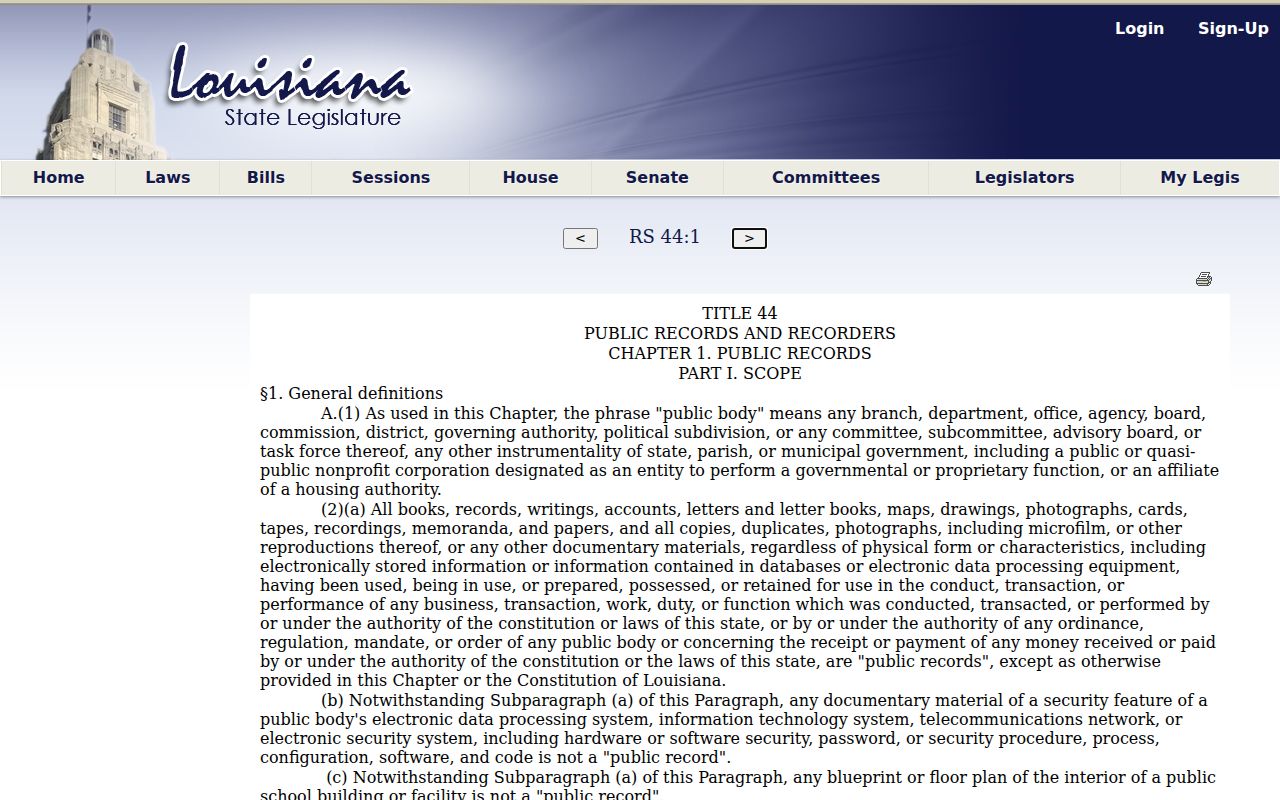
The statute does not make every field open. Other laws protect juvenile and expunged information, victim identifiers, confidential sources, and specified investigative facts. Ask for a public copy with protected portions removed when full release is not allowed.
Writing a Converse Criminal Records Request
Name one custodian and one document. For the verified law-enforcement agency, request the initial report for a dated event. For the sheriff, request the Article 228 booking entry. For the village court, request the citation docket and judgment. For the district clerk, request minutes or a certified disposition. Include a narrow date range, incident or case identifier, delivery choice, and certification need.
Ask the office to identify any withholding law and release segregable public portions. Avoid demands for juvenile, expunged, victim, confidential-source, or protected investigation material. A focused request makes it easier for a small office to locate the right file and state the current copy charge or expected response method.
Public Access Rules for Converse Records
The Converse custodian must apply Louisiana Public Records Law together with record-specific limits. R.S. 44:3 protects specified follow-up investigative material during pending litigation but preserves initial reports, listed booking information, summons or citations, and filed bills of information. Separate rules govern district minute access and confidential records.
Key Statutes:
Louisiana Public Records Law, R.S. 44:1 broadly defines records held by public bodies.
Louisiana R.S. 44:3 protects certain investigations while preserving key initial and booking records.
Louisiana R.S. 33:441 establishes Mayor's Court jurisdiction over municipal ordinance violations.
Expunged records are confidential under Article 973, and juvenile dissemination is restricted. Use official Converse, sheriff, and court sources. Verify any result with the office that created it, and keep the record's stage and limits attached to the conclusion.